
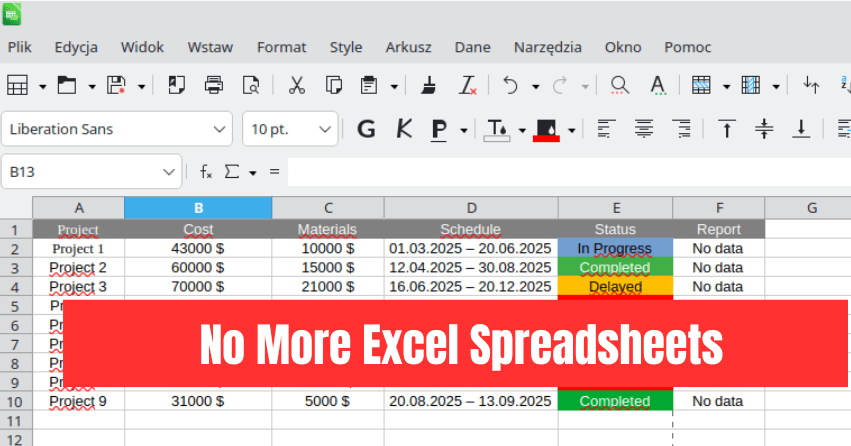
During Contractors.es implementations, I noticed a recurring pattern that has become almost a classic. At the very beginning, construction company owners often smile nervously when they hear that we are talking about managing their business without Excel.
“Transferring these spreadsheets will take forever…” they say. And it’s easy to understand why – dozens of projects, hundreds of hours of work, and an enormous amount of data to organize. This scenario appears in almost every implementation, even before any real work begins.
Usually, it only becomes clear after a longer conversation that the source of these concerns is not technology itself, but rather the fear of change and the potential loss of control over data that has been recorded in spreadsheets for years. That is when the real conversation begins – about what can be gained when construction management software actually starts supporting the business, instead of just adding another set of Excel files.
Initial Reactions and Spreadsheet Challenges
It often looks very similar: owners open their dozens, sometimes hundreds, of Excel spreadsheets, and it quickly becomes apparent that there is no coherent view of their projects. Schedules are in one file, cost estimates in another, and construction reports arrive late or incomplete.
At times like this, one sentence is often repeated:
“I don’t know the real status of the project…”
That’s when I show that a construction management system can bring all this information into one place. The first time the system is launched, and the owner gets a quick overview of project statuses, costs, and crew working hours, the reaction is almost always the same:
“I didn’t realize it was possible to have so much data in one place.”
This is the moment when the initial resistance to change clearly starts giving way to curiosity and genuine interest.
Tracking and Managing Working Hours – Order Instead of Chaos
On construction sites, paper timesheets, scattered notes, and phone calls asking about hours worked are still common. Owners admit that in these conditions it’s hard to verify the actual working hours of teams.
A recurring concern often arises during conversations:
“The reports will be incomplete, and I won’t know who actually worked how many hours.”
The difference becomes visible almost immediately when employees start using the Contractors.es mobile app for field workers. Working hours are entered directly into the system, assigned to specific projects, and always up to date. Owners gain a complete, coherent picture of team activity, and time tracking ceases to be a source of uncertainty.
Chaos gives way to order, and decisions begin to rely on reliable data rather than guesswork.
Project Planning – Ending Scheduling Chaos
The promise of real improvement in project planning is often met with mild skepticism. Construction company owners admit that in Excel it’s difficult to quickly see which team is available, who can start the next project, and what changes have already been made. Each adjustment means new versions of spreadsheets and added stress.
The change occurs when the company starts using the Contractors.es system. Instead of multi-page spreadsheets, a clear, interactive project and team planner appears. Assignments, deadlines, and crew availability are all visible in one view, which greatly simplifies daily organizational decisions.
Data Migration – Not as Scary as It Seems
In practice, it quickly becomes clear that transferring data is neither as complicated nor as time-consuming as owners initially assume. Importing spreadsheets into Contractors.es and automatically assigning data to projects, teams, and budgets almost always triggers the same reaction – first surprise, then clear relief.
The most important takeaway after implementation is always the same: change does not mean losing control. On the contrary – order in projects and full visibility into the company’s status appear faster than anyone expected.
When Excel ceases to be the primary management tool and all information becomes available in a single, coherent system, the daily work of a construction company begins to look completely different.
Based on experience – Beata Bukowska, Implementation Specialist, Contractors.es